Type to search 60+ products, specs and articles
We turned the questions customers ask us most into short articles and videos. No jargon — enough to judge which specification fits.
 Video · 8:21
From M2 to M6, 5 mm to 30 mm — which standoff goes where on the same board. Eight minutes, aimed at buyers and mechanical engineers new to board-level hardware.
Video hosted on YouTube; copyright belongs to the original creator
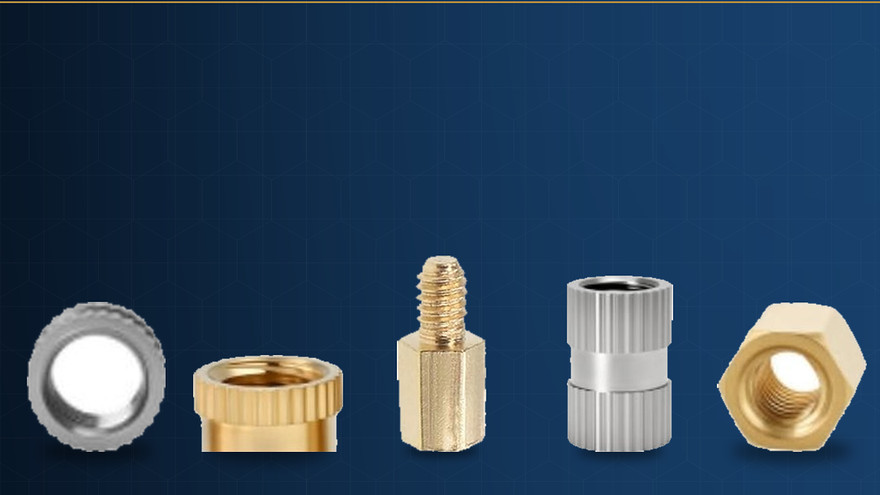
Watch on YouTubeStraight knurl suits most thermoplastics for heat-staking or ultrasonic installation. It locks against the hole wall with stable torque resistance and is the easiest profile to tool — which is why it is our highest-volume type.
Diamond knurl gives higher pull-out resistance, useful where the wall is thin and the axial load is high. It needs more insertion force, so ultrasonic power must be raised or the insert will not seat fully.
Plain bodies rely on interference fit and are only recommended with adhesive or a secondary locking feature. Our selection order: plastic first (ABS / PC / PA66), then installation process, then profile and length.
Total length of a male-female standoff = board gap + female thread engagement. Engagement should be at least 1.5 × thread diameter: 4.5 mm for M3, 6 mm for M4.
For female-female standoffs, take the board gap minus the thickness tolerance of both boards. Always err long: a long standoff can be shimmed, a short one has to be replaced.
Where a shield can or heat sink is pressed on, leave another 0.2–0.3 mm of compression allowance, otherwise the standoff bows the board.
Tape-and-reel packaging suits automatic placement. The tape direction must match the placement program, or parts will be flipped or missed.
The pad opening is usually 0.1–0.2 mm larger than the nut OD. Too large and the part drifts; too small and it sits proud, causing a cold joint.
Check torque after reflow — 1.5–2.0 N·m is a common requirement for M3, to be confirmed against your assembly.
304 is fine indoors, in dry conditions or general outdoor use. 316 contains 2–3% molybdenum, resists chloride pitting noticeably better, and costs roughly 1.4–1.8× more.
For coastal projects, seaside plants, wash-down equipment and medical devices, go straight to 316 rather than trialling 304.
Stainless still rusts: machining swarf left in threads and unremoved weld scale become corrosion initiation points. Passivation before shipment is not optional.
RoHS covers restricted substance content (lead, cadmium, mercury, hexavalent chromium and six more). It proves the part itself is within limits and is the entry requirement for the EU.
REACH-SVHC covers declaration of Substances of Very High Concern. EU importers use it to decide whether notification is needed — it is about presence, not about exceeding a limit.
MSDS is a material safety data sheet for handling and transport, not an environmental certificate. We hold all three for C3604 brass and ship them with the goods.
24 h typically covers indoor parts or short-term protection; 48 h is the common threshold for exported fasteners; 96 h and above is for outdoor, automotive and coastal projects.
Zinc plus passivation, nickel plating and black oxide with grease differ widely — the same base material can vary by 3× in hours.
Results depend heavily on threads and edges. Write the acceptance criteria as rating + hours + test method so both sides measure the same thing.
Custom work to drawing or sample is welcome, and we are happy to send samples for testing first. Leave your contact and an engineer will reply directly.